

Restoring Oak Woodlands at the Los Angeles Zoo
October 22, 2025
Mapping Resilience: Integrating GIS & Modeling to Build Fire-Adapted Landscapes
November 19, 2025Restoring Oak Woodlands at the Los Angeles Zoo
October 22, 2025Mapping Resilience: Integrating GIS & Modeling to Build Fire-Adapted Landscapes
November 19, 2025Resilient Landscapes
at the Wildland Urban Interface
William Stratton & Julie Johnstone
November 11, 2025
Great Ecology provides a suite of fire resilient landscape services, ranging from community wildfire protection plans, brush management plans to long-term wildfire planning. Our specialists, including ecologists, scientists, planners and landscape architects, collaborate on projects to ensure long term community and site viability.
This blog is part of our Fire Resilient Landscapes blog series so stay tuned for additional content exploring fire and similar climate change driven impacts.
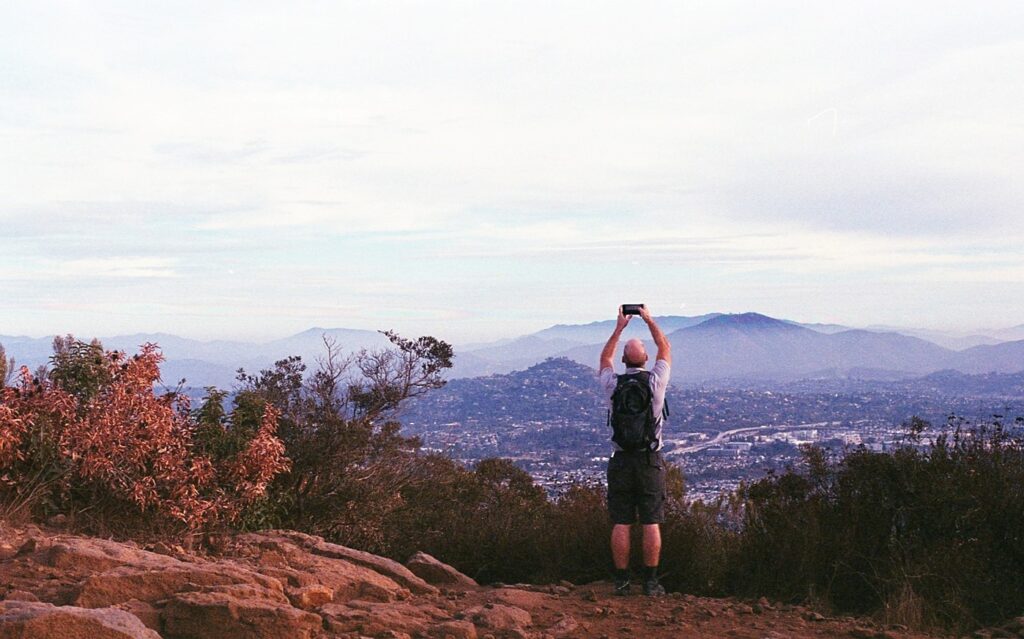
San Diego's landscape is a complete gradient of urban to wild, with wild canyons and rolling hills never far from a subdivision or urban core. San Diego has over 500 linear miles of Wildland Urban Interface, some seen here from a hike on Cowles Mountain. Source: Billy Stratton
The Wildland Urban Interface (WUI) is the edge or interface, between urban development and wild open spaces. In southern California, it exists where homes are perched above wild canyons and where neighborhoods and businesses abut rolling hills of chaparral, coastal sage scrub, and other wild open spaces. San Diego has over 500 linear miles of WUI. As development expands, pushing outward and especially inland toward drought-afflicted and fire-suppressed open space, the WUI also shifts and expands. Wildfires pose an increasing threat to urban areas in southern California and elsewhere, tragically demonstrated by the Palisades and Eaton fires in January 2025; it is up to homeowners to understand laws, guidelines and their ultimate responsibility to tend their land and prevent excessive damage to their property from wildfires.
Wildfire prevention at the WUI is coded at various state and local levels. Under 2022 California Fire Code, owners of properties in Local Responsibility Areas designated as Very High Fire Hazard Severity Zones (San Diego zones are identified on a map located here: https://www.sandiego.gov/fire/community-risk-reduction/fire-hazard-severity-zones) must manage their property to prevent damage from wildfires. Under the state-wide fire code, fire code officials require a fire protection plan for most new development in this zone, including additions and some remodels for existing homes. San Diego Municipal Code requires brush management in all areas which contain native or naturalized vegetation and are within 100’ of a structure. Additionally, San Diego law requires a brush management plan as part of any proposed development in the Very High Fire Hazard Severity Zones requiring discretionary entitlements, grading, and/or building permits.
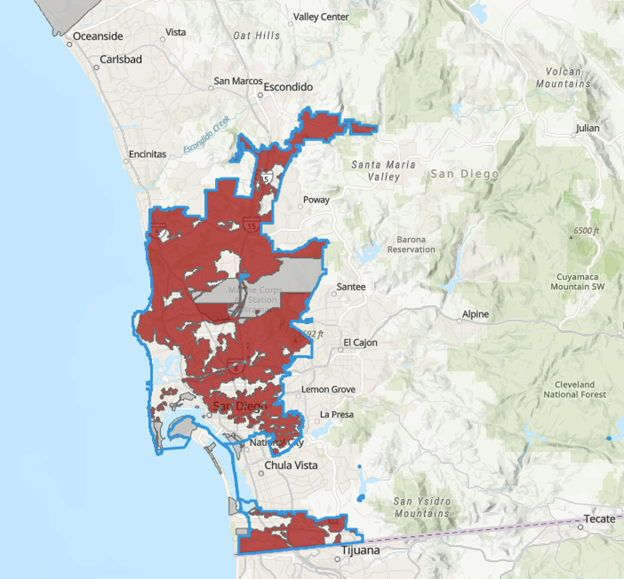
Very High Fire Hazard Severity Zone map for San Diego, 2025. From https://www.sandiego.gov/fire/community-risk-reduction/fire-hazard-severity-zones.